Retro space geek shoots Jupiter with 1998 Game Boy Camera
While big tech spends billions trying to convince us we need 200-megapixel AI-bloated cameras to photograph a blurry moon, one absolute legend went in the completely opposite direction. Prepare to have your mind blown by the ultimate retro-futuristic crossover.
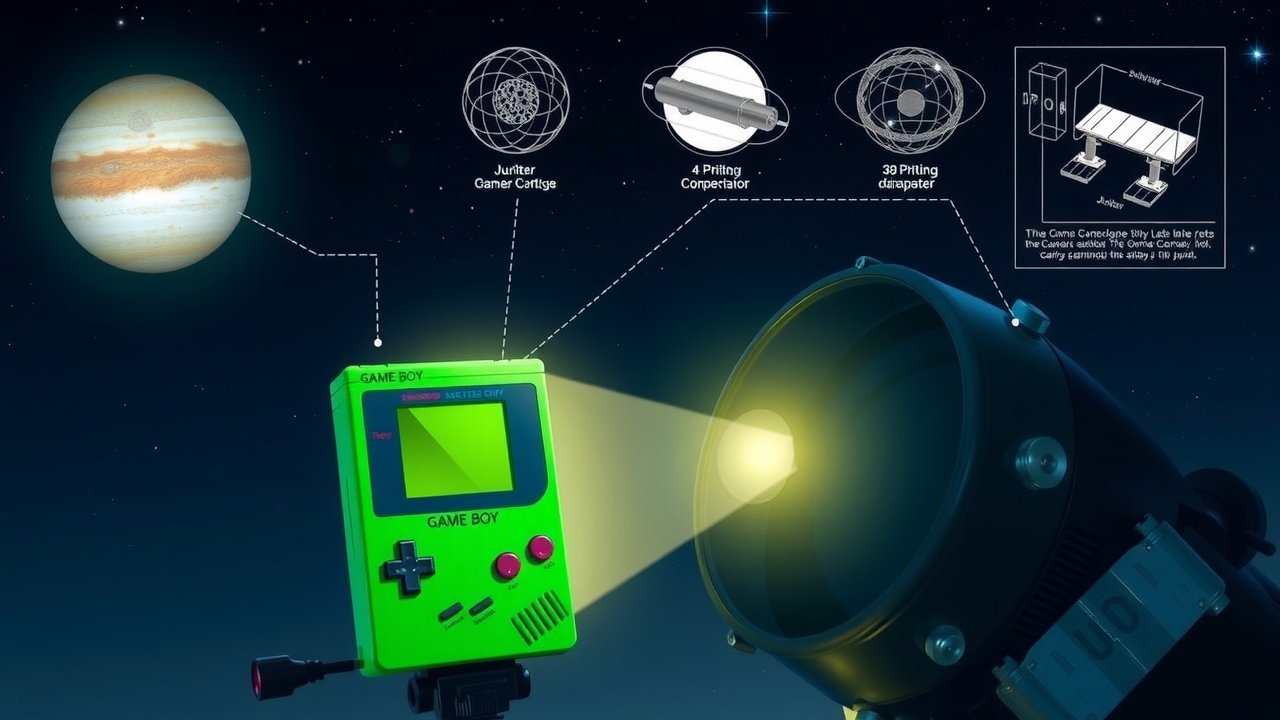
Musician and filmmaker Chris Graue used a custom 3D-printed adapter tube to hook up a heavily modified 1998 Game Boy directly into the 1.25-inch eyepiece of a massive telescope at the historic Mount Wilson Observatory in California.
The camera in question is the legendary 2-bit peripheral that shoots at a mind-boggling resolution of 128 by 112 pixels in just four shades of gray. To make this technological crime possible, Graue used a console modded with a backlit screen and a custom lens mount. Because why buy a dedicated astrophotography rig when you can repurpose a 26-year-old handheld console designed for kids?
The original plan was to capture the Moon, but the celestial neighbor proved to be too close and blindingly bright for the observatory's massive optics. Pivoting on the fly, the creator aimed the telescope at Jupiter instead, capturing a grainy but recognizable image of the gas giant, complete with its iconic cloud bands and planetary disk.
The niche Game Boy Camera astrophotography community—yes, that actually exists—instantly went wild, confirming that Graue broke two records at once: the longest lens and the most distant object ever captured on the vintage hardware. He has already uploaded the 3D adapter blueprints and a video tutorial online for anyone else who wants to ruin a multi-million dollar telescope with 90s tech.
It turns out that humanity doesn't need multi-billion-dollar space telescopes to touch the stars when a piece of obsolete plastic from the last century can do the job with vibes alone. One can only wonder how many more classic gaming consoles are currently waiting to be strapped to scientific equipment just to prove a point.
Source: YouTube
Comments
Help shape the next version: Add context or suggest a correction. AI review can add points toward a rewrite. Reviews and updates may take time; a full meter does not guarantee a new version.