Scientists Kill 99% of Cancer Cells With Infrared-Activated Molecular Jackhammers
Forget toxic chemicals and brutal radiation. Biologists have figured out a way to literally vibrate tumor membranes to pieces using a harmless medical dye and a laser pointer. This is the kind of sci-fi future we actually signed up for.
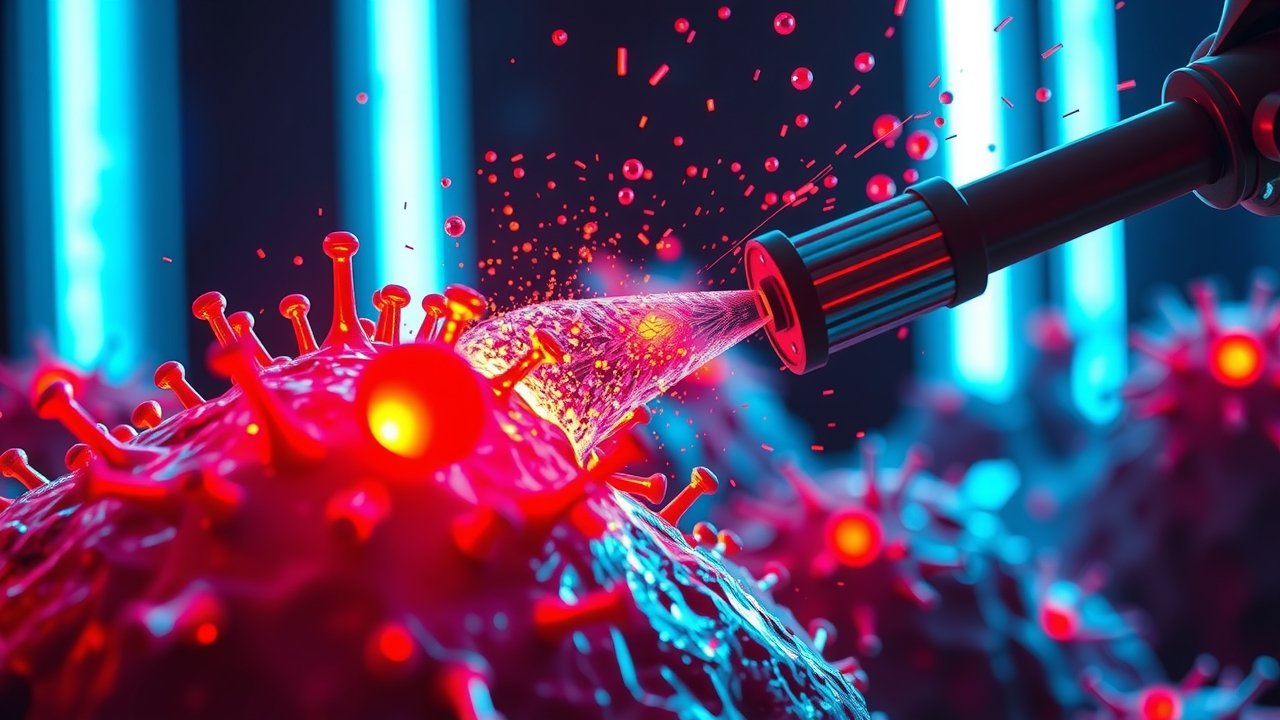
The new method weaponizes aminocyanine molecules, which are synthetic dyes already widely utilized in medical imaging to spot bad cells. Chemist James Tour from Rice University and his team realized these molecules have a neat trick: when blasted with near-infrared light, they enter a state of absolute kinetic frenzy.
This light causes the molecules to vibrate in perfect sync about 40 trillion times per second, behaving like microscopic jackhammers that physically tear open cell membranes. Because the destructive force is purely mechanical rather than chemical, the target cells are utterly clueless about how to mutate and build up resistance, unlike their typical reaction to standard chemo drugs.
The team first proved this concept by wiping out cancer cells in lab dishes, followed by mouse trials where half of the melanoma cases were completely cured. The researchers then expanded their toolkit in late 2024, designing multiple variations of these molecular jackhammers to customize them for different types of tumors.
Crucially, near-infrared light can travel deep into human tissue without causing damage, meaning internal tumors in bones or organs could eventually be blasted without a surgeon having to slice anything open. When the light is switched off, the inactive dye molecules simply drift away and are harmlessly flushed out of the body by healthy cells.
If these mechanical cell-shredders make it through human trials, the entire multi-billion-dollar chemotherapy industry might have to find a new way to justify its agonizing existence. Of course, the real challenge will be keeping the treatment affordable before some pharmaceutical titan buys the patent and locks it behind a paywall.
Source: Advanced Science
Comments
Help shape the next version: Add context or suggest a correction. AI review can add points toward a rewrite. Reviews and updates may take time; a full meter does not guarantee a new version.