Penn Physicists Just Taught Photonic AI Chips How to 'Think' Without Electricity
Light-based AI chips have always been a beautiful lie: incredibly fast at math, but totally helpless when it comes to making actual decisions. That is, until some absolute geniuses decided to bend the laws of physics.
Traditional silicon chips are sweating themselves to death trying to keep up with massive AI models, which is why scientists have been obsessed with optical computing. Photons are perfect for blasting through massive matrix multiplications because they travel at the speed of light, generate zero heat, and do not crash into each other. But this perfect harmony is also their biggest flaw: because light particles do not interact, they cannot handle the crucial "if-this-then-that" decision-making steps, known as activation functions, that make neural networks actually smart.
To get around this, hybrid systems had to constantly convert light back into electricity, let a classic electronic circuit make the decision, and then shoot it back as light. This constant back-and-forth conversion completely murdered the speed and energy efficiency of the entire operation, turning a futuristic light-speed processor into a glorified, lagging adapter.
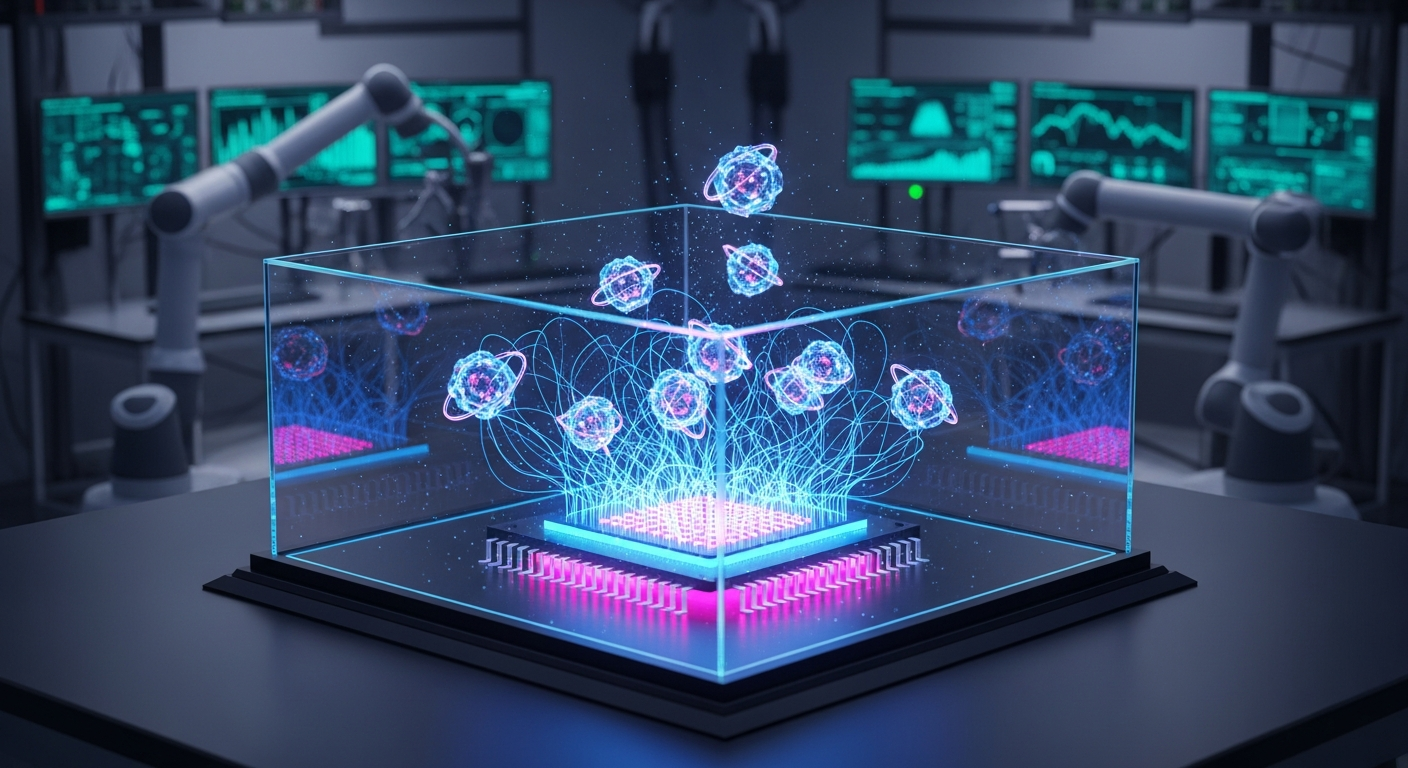
A research team at the University of Pennsylvania led by Bo Zhen bypassed this bottleneck by literally breeding a hybrid particle. They forced a photon to merge with an exciton, creating a weird, half-light, half-matter beast called an exciton-polariton. This Frankenstein particle flies at the speed of light but retains enough material ego to interact with its surroundings and switch signals on the fly.
To pull this off, the physicists trapped an atomically thin layer of molybdenum diselenide inside a nanoscale silicon nitride optical cavity. This tiny cage squeezes light down to a mind-boggling 0.05 cubic micrometers, which is essentially the microscopic equivalent of a packed subway car where the light has no choice but to bump into matter. This tight squeeze triggers a powerful non-linear response, allowing the chip to perform optical switching using a microscopic 4 femtojoules of energy.
Exactly 80 years ago, the very same university birthed the ENIAC, dragging humanity kicking and screaming into the era of electronic computing. Now, the same institution wants to put electrons out of a job entirely. It is a poetic betrayal of silicon, and if this tech scales, the entire global semiconductor supply chain is going to look like a collection of bronze-age relics.
Source: Penn Today
Comments
Help shape the next version: Add context or suggest a correction. AI review can add points toward a rewrite. Reviews and updates may take time; a full meter does not guarantee a new version.