Exoplanet magnetic fields proven because their 25,000 km/h winds are weirdly 'too slow'
We finally have proof that worlds outside our cosmic backyard are wrapped in invisible magnetic blankets. It turns out physics in deep space is even wilder than we imagined, and it took some seriously bizarre weather observations to prove it.
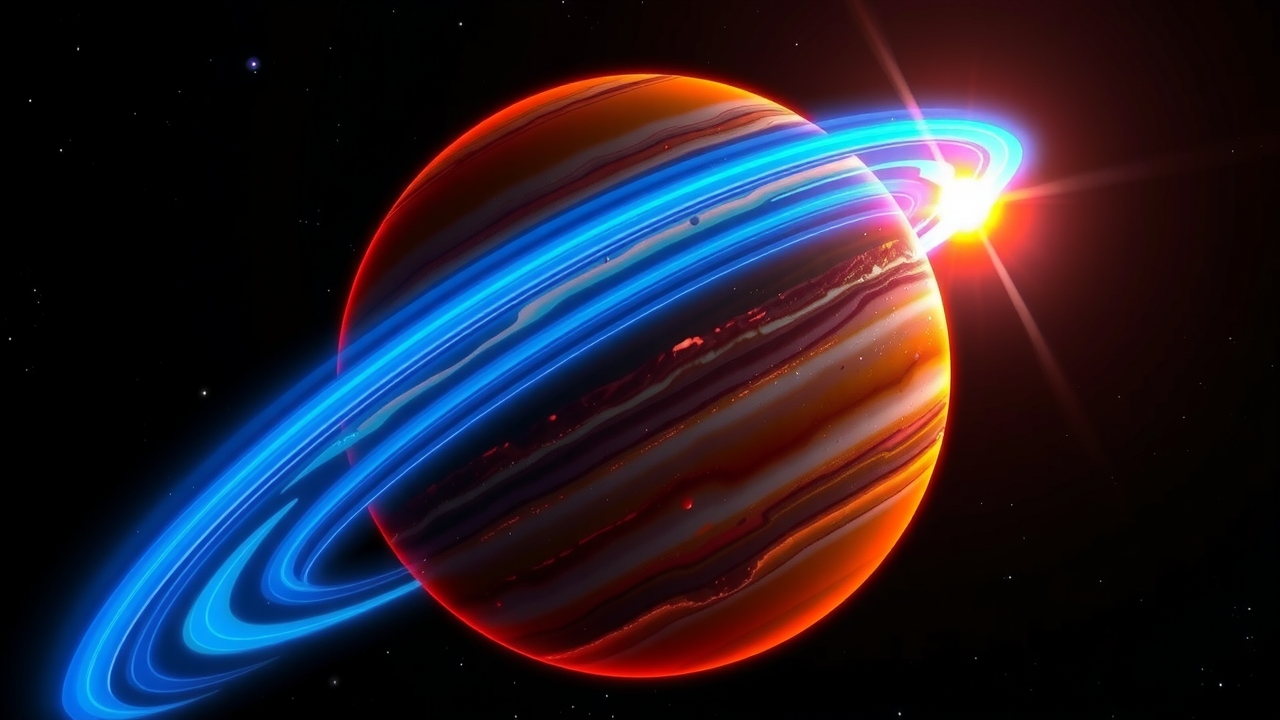
A team of astronomers pointing telescopes in Chile and Hawaii at seven massive gas giants known as "hot Jupiters" just cracked a cosmic mystery. These giant balls of gas orbit ridiculously close to their parent stars, making our own scorched Mercury look like a cozy winter resort. Because they are tidally locked, one side of these planets is permanently melting under star-fire while the other side is frozen in perpetual night, creating a planetary-scale blow dryer of epic proportions.
Under normal atmospheric physics, blasting more heat into a planet's atmosphere should act like pouring high-octane fuel onto a fire, sending wind speeds into absolute overdrive. Instead, lead researcher Julia Seidel from the Lagrange Laboratory in Nice noticed a mind-bending paradox: the absolute hottest of these cosmic hellholes actually had the weakest winds.
This bizarre atmospheric slowdown is the smoking gun proving that these exoplanets possess active magnetic fields. The only physical mechanism capable of slamming the brakes on winds screaming across a planet at these extreme temperatures is magnetic drag, created as the planet's magnetic shield interacts with highly charged, ionized particles in the superheated air.
While these giant gas bags are definitely not hosting any alien life unless they prefer living in a 25,000 km/h magnetic blender, the discovery confirms a crucial planetary defense mechanism exists far beyond our solar system. The magnetic fields observed on these seven planets, while smaller than the monster shield generated by our own Jupiter, are perfectly comparable in strength to the magnetic fields generated by the planets in our own solar system.
So, the universe has magnetic shields everywhere, meaning habitable planets might actually be common. Too bad humanity is still busy arguing on the internet instead of building the warp drives needed to go see them.
Source: Nature Astronomy
Comments
Help shape the next version: Add context or suggest a correction. AI review can add points toward a rewrite. Reviews and updates may take time; a full meter does not guarantee a new version.